
Research Advisor: Samantha Bond, MS, CMI
Research Committee: Scott Barrows, MS and Rex Twedt III, MS
Content Experts: Leslie R. Carnahan, PhD, MPH and Mary Stapel, MD
Media: Blender, Adobe Creative Cloud (After Effects, Audition, Photoshop, Premiere Pro)
Audience: General Vietnamese Speaking Audience
About: The research project tested whether a Vietnamese-speaking audience’s comprehension of medical knowledge and English medical terminology improves when watching a bilingual animation.
Animations
Research Background
Question: How could an animation be developed to improve understanding of colorectal cancer screenings in Vietnamese-speaking audiences?
Objective: The main objective in creating a bilingual animation in Vietnamese and English is to understand how to better design an animation to be more accessible for an audience facing a language barrier and to improve the audience’s health literacy so that they can connect the information, they understand in Vietnamese to English medical terms.
Problem: The Asian American population is largely impacted by cancer as the number one cause of death2. Compared to other racial/ethnic groups in the U.S., Asian Americans also have one of the lowest rates for cancer screenings, including colorectal cancer (CRC) which is the second leading cancer death in Asian Americans2. Asian-American patients may experience language barriers with English-speaking healthcare providers, due to being linguistically isolated or not having a translator available to assist in scheduling or attending the appointments4. At least 68.8% of the Vietnamese American population in 2010 were immigrants and 54.8% of the total population do not speak English proficiently1. The language barrier concerns are often addressed but are not improved in most intervention methods.
Significance: There is potential to improve it by increasing Vietnamese-speaking individuals’ comprehension of English medical terminology with an animation that uses two languages. The term bilingual can refer to something being written or conducted in two languages. For clarity, this research will refer to the primary research stimulus, an animation, as a bilingual language animation. Research on creating visual content to fit the accessibility needs of an audience facing a language barrier in healthcare is limited in general, and research investigating those needs for a Vietnamese-specific population is even fewer1. The study can be a beneficial source of knowledge for individuals with an interest in creating audiovisual media that is designed to be more inclusive to an audience that is often excluded from research or healthcare resources due to a language barrier.
Study Design
Deliverables: An animation with mostly Vietnamese and had medical terms repeated in English and an English version with medical terms repeated in Vietnamese was created. The mostly Vietnamese version was shared with study participants and the English version was shared with the committee for feedback.

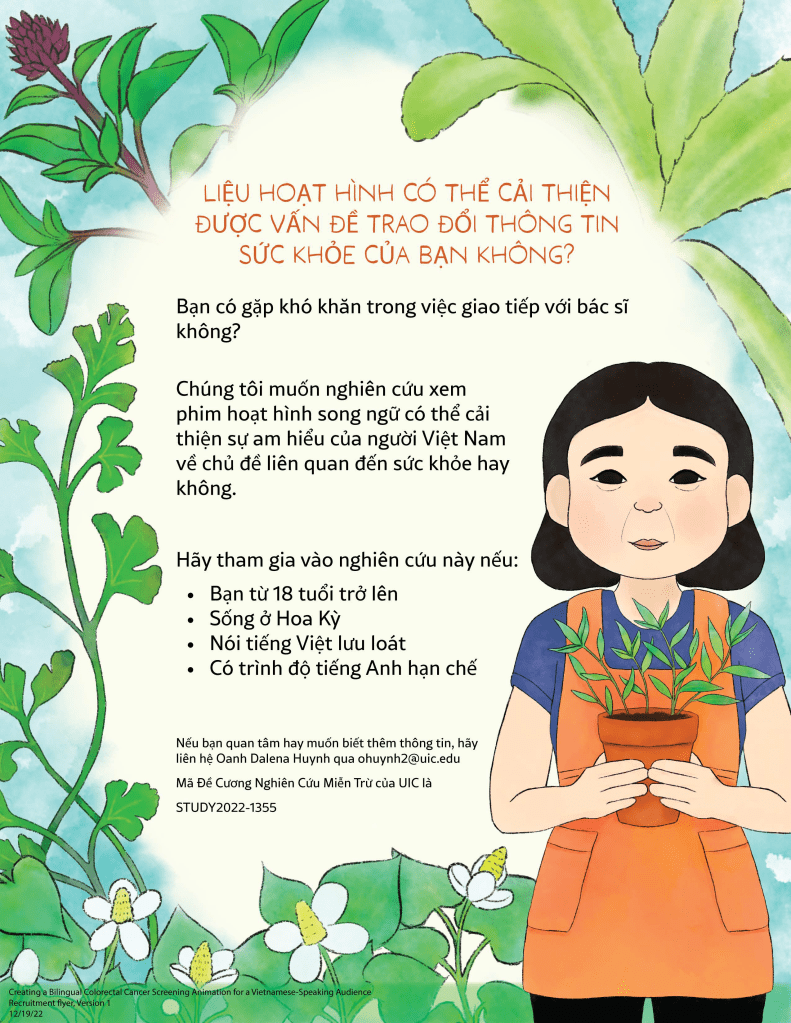
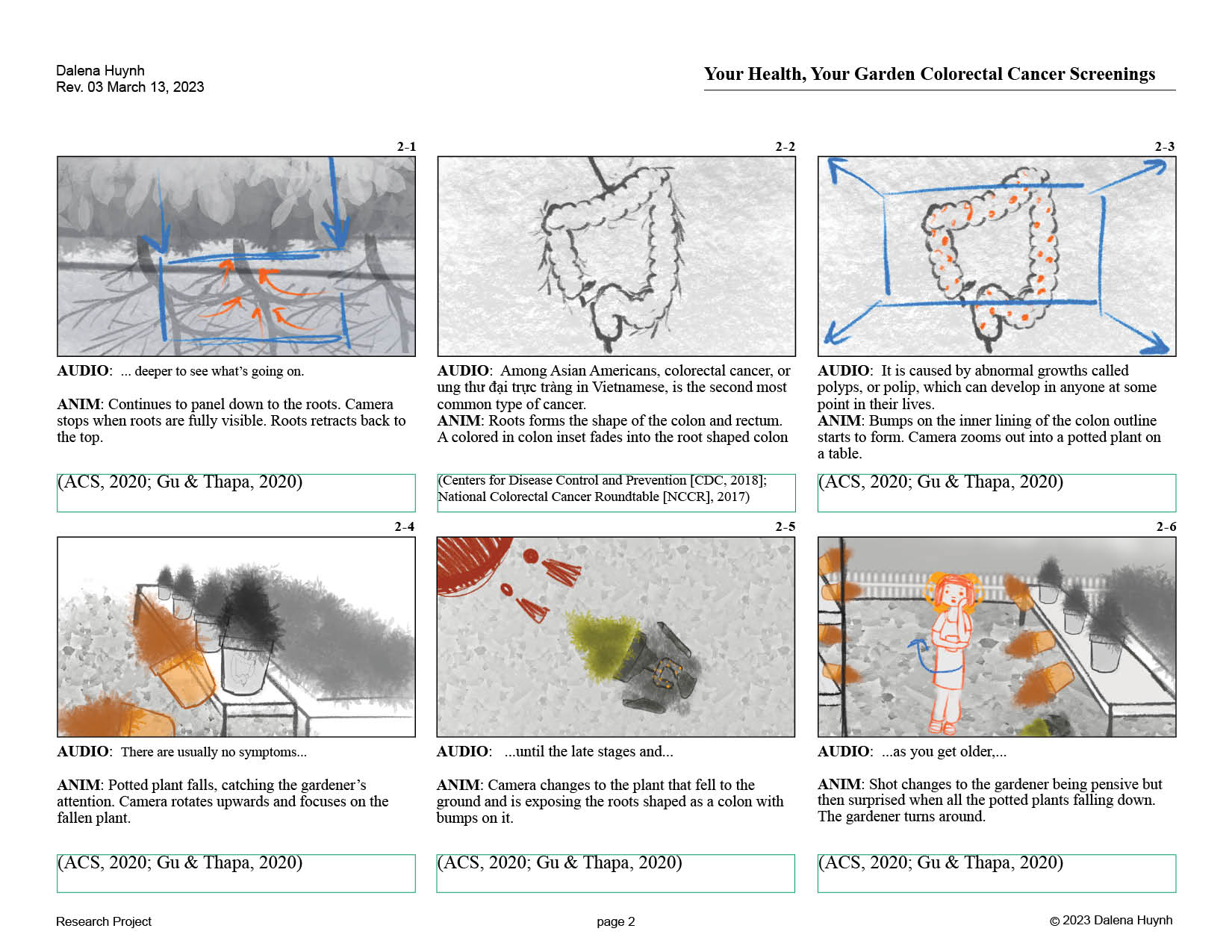
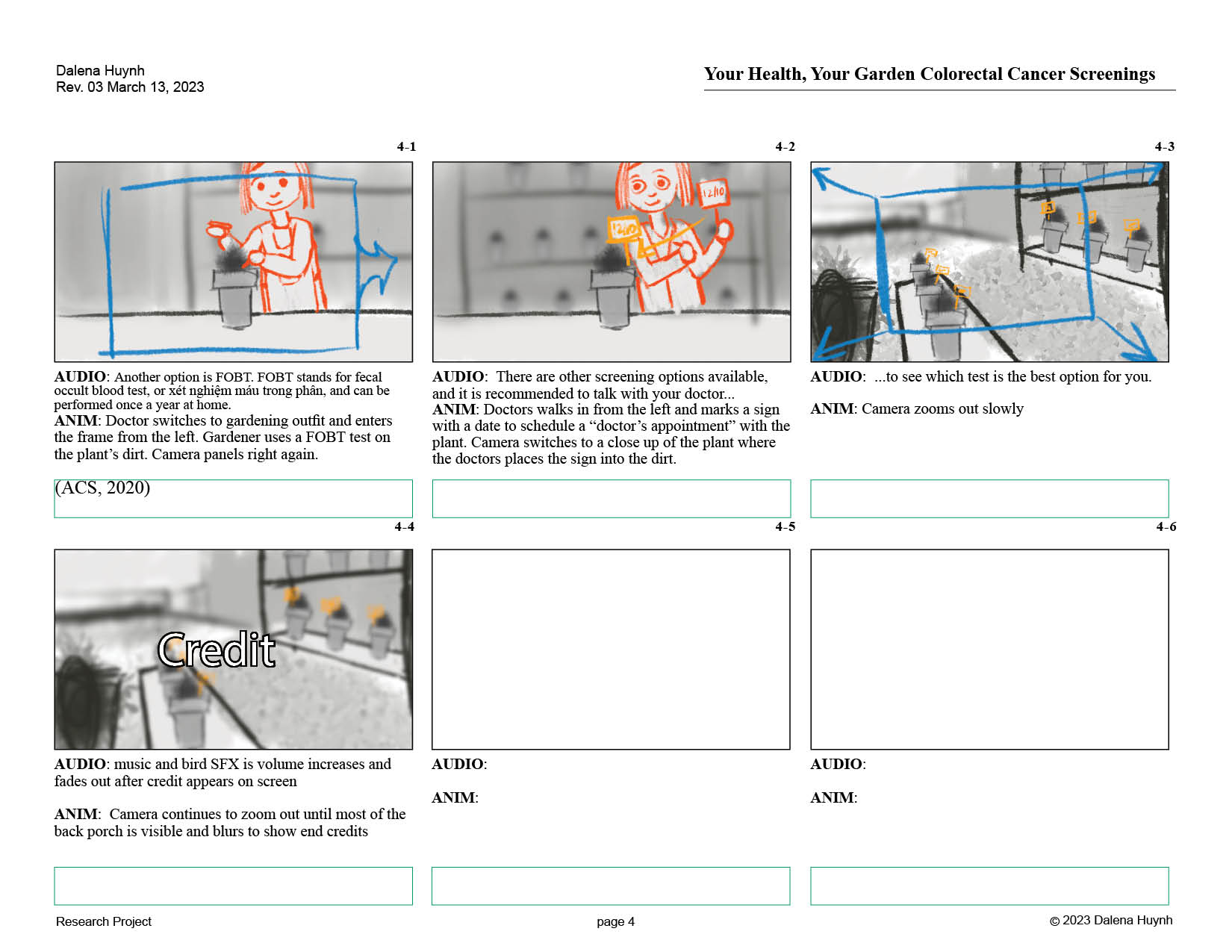
Interviews with professionals involved in underrepresented community outreach or teaching ESL and input from the committee and content experts helped develop the script and storyboard for the animation. The script was translated by a medically certified translator in Vietnamese. The approved script was narrated mostly in Vietnamese and included some medical terms repeated in English. Another voiceover is mostly in English, and some medical terms are repeated in Vietnamese for the committee review.

The completed animation tied Vietnamese culture and colorectal cancer screening into a visual metaphor and incorporated Vietnamese, English, and phonetics callouts into the animation without overloading the learner’s cognitive capacity (shown in figure 2)3. The content of the animations focused on introducing what CRC is, CRC’s impact on Asian Americans, the risk factors and symptoms of CRC, and the most common types of test screenings. The animation was completed as a 2.5D animation using Blender, Adobe Creative Cloud©, specifically, Photoshop, After Effects, Premiere Pro, and Audition. After the completion of the animation, recruitment emails and flyers were distributed, and participants were tested through an online survey.
The survey collected qualitative and quantitative data on the participants. Quantitative questions focused on their knowledge of relevant English-Vietnamese medical terms. Qualitative data focused on relevant information about the participants such as their English and Vietnamese proficiency, whether they are being assisted by someone with technology, familiarity with colorectal cancer and screening types, learning experience, the usability of the animation format, etc. The data collected through the study analyzed the correlation between being exposed to English medical terms alongside Vietnamese medical terms and the participants’ ability to build a connection between the terms.
References
- Holland, A. T., & Palaniappan, L. P. (2012). Problems with the collection and interpretation of Asian American health data: Omission, aggregation, and extrapolation. Elsevier BV. https://doi.org/10.1016/j.annepidem.2012.04.001
- Kim, K., Chandrasekar, E., & Lam, H. (2015). Colorectal cancer screening among Chinese, Cambodian, and Vietnamese immigrants in Chicago. Journal of Racial and Ethnic Health Disparities, 2(4), 473-480. https://doi.org/10.1007/s40615-015-0095-x
- Mayer, R. E., Hegarty, M., Mayer, S., & Campbell, J. (2005). When static media promote active learning. Journal of Experimental Psychology. Applied, 11(4), 256-265. https://doi.org/10.1037/1076-898X.11.4.256
- Nguyen, B. H., McPhee, S. J., Stewart, S. L., & Doan, H. T. (2010). Effectiveness of a controlled trial to promote colorectal cancer screening in Vietnamese Americans. American Journal of Public Health (1971), 100(5), 870-876. https://doi.org/10.2105/AJPH.2009.166231
- Nguyen, T. X. H., Tran, T. B. N., Dao, T. B., Barysheva, G., Nguyen, C. T., Nguyen, A. H., & Lam, T. S. (2022). Elderly people’s adaptation to the evolving digital society: A case study in Vietnam. MDPI AG. https://doi.org/10.3390/socsci11080324





 Dalena Huynh